

October 2026
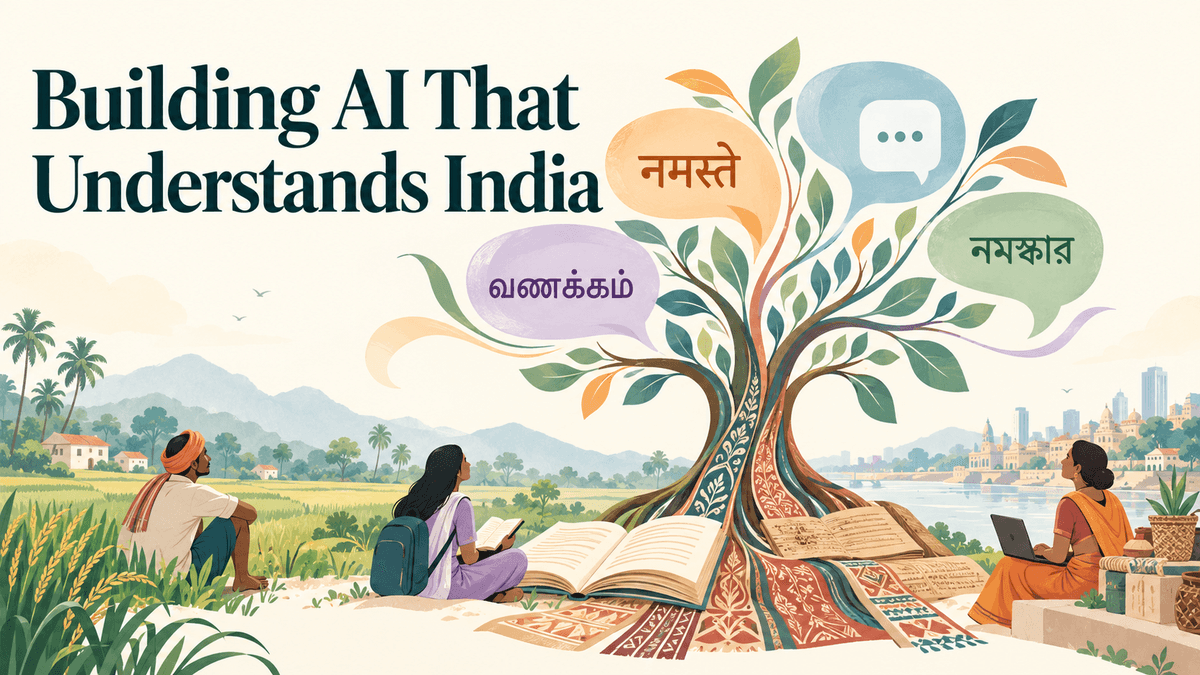
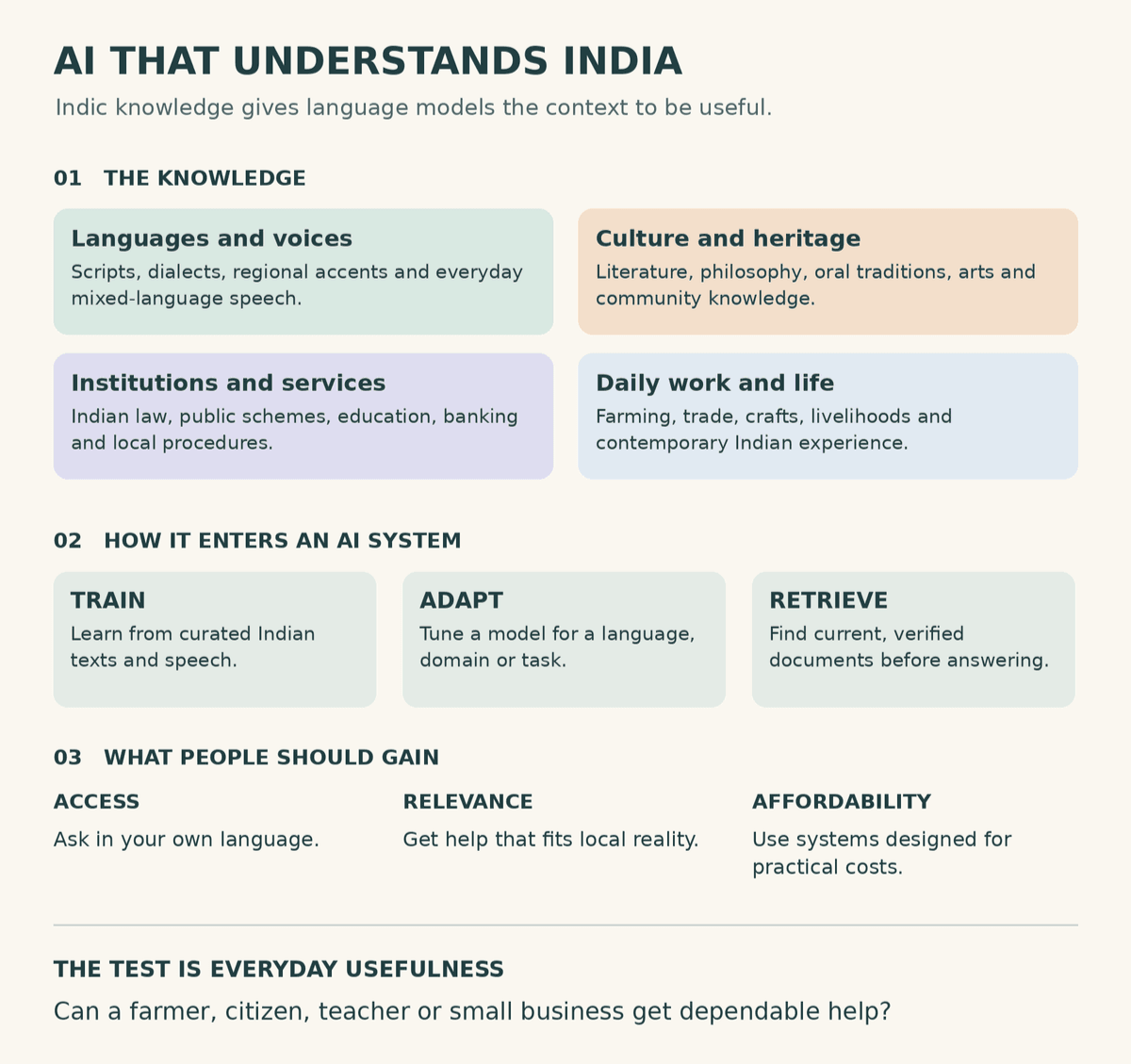
Indic knowledge is the knowledge created, practised and passed on across the Indian subcontinent. It includes philosophy, literature, mathematics, medicine, art, crafts and oral traditions. The term can be used more broadly to include contemporary Indian life. How our institutions work, how people farm and trade, how families communicate, and how public services reach citizens.
This knowledge lives in many languages and forms. Some is recorded in books and manuscripts. Some sits in court judgments, school textbooks and agricultural guides. Some travels through stories, songs and conversations. India has many overlapping traditions, often with different interpretations. An AI system needs to recognise that diversity.
A large language model, or LLM, learns patterns from vast amounts of text so it can answer questions, explain ideas and generate content. What it learns depends heavily on what it encounters during training. If Indian languages and experiences are poorly represented, its understanding of India can be incomplete, even when its answers sound fluent. Models built in America or elsewhere outside India do not adequately represent such Indic Knowledge.
Why Indian knowledge matters
Imagine a farmer asking about a failed monsoon, a shopkeeper asking about a GST notice, or a student trying to understand a regional poem. Useful answers require knowledge of local crops, Indian institutions and cultural meaning. Translating a generic English answer cannot always provide that understanding.
Language also carries context. People mix Hindi with English, write Tamil in Roman letters, speak in regional dialects and use expressions whose meaning depends on the situation. An assistant that handles textbook language but struggles with ordinary conversation will be difficult to use.
There is an economic dimension too. LLMs process text in small units called tokens. A system poorly suited to Indian scripts may need more tokens to handle the same information, increasing cost and slowing responses. Developers such as Sarvam and Gnani are explicitly working on this problem.
Indic knowledge therefore matters for access, relevance and affordability. It also gives India greater influence over how its people and traditions are represented in AI. But local fluency does not guarantee factual accuracy. An Indian model still needs careful testing and reliable sources.
The larger efforts taking shape
BharatGen offers a national research route. Led by a consortium anchored at IIT Bombay, it combines work on text, speech and document understanding. A February 2026 government announcement reported the launch of Param 2, a 17 billion parameter text model covering all 22 scheduled Indian languages. It also reported domain models called Ayur Param, Agri Param and Legal Param, for Ayurveda, agriculture and Indian law. This is a particularly direct example of connecting Indian language AI with bodies of Indian knowledge. Availability and performance must still be checked for each model and use case.
Sarvam AI has become a prominent Indian model developer. In March 2026, it released the weights of Sarvam 30B and Sarvam 105B, reasoning models trained in India using IndiaAI Mission compute. Its published work covers multilingual training data, efficient processing of Indian scripts and evaluation in both native and Romanised writing. This illustrates how language support needs attention throughout model development, rather than only at the final interface.
Smaller teams are widening the field
Soket AI shows how a smaller research team can contribute through both models and data. Its Pragna 1B release supports Hindi, Gujarati, Bengali and English. The original technical account describes adapting TinyLlama through vocabulary expansion and further training, alongside the Bhasha datasets. One India-focused subset selects material relevant to Indian context. Soket's larger Project EKA programme remains labelled as in training on its website, so it should be distinguished from an already released model.
CoRover takes a practical approach through BharatGPT and its conversational AI products. The public BharatGPT 3B Indic model card describes a fine-tuned model for multilingual generation, translation and summarisation. It recommends connecting the model to a knowledge base rather than treating it as an up-to-date standalone chatbot. For Indian services, that matters: an assistant should find the relevant circular or policy document before explaining it in the user's language.
Gnani AI connects language models with speech technology and enterprise workflows. Its Artha stack, unveiled in August 2026, includes Evon, which the company describes as trained across eleven Indian languages, together with speech recognition and speech generation models. Its focus on regional accents, mixed-language speech and efficient text processing addresses the way many Indians actually interact with services. These are developer descriptions, rather than proof that every proposed application has been deployed successfully.
The shared foundations matter
Behind these visible products is essential work on datasets and language tools. AI4Bharat at IIT Madras has released resources including IndicLLMSuite for training Indian language LLMs and IndicTrans2 for translation across all 22 scheduled languages. IndicTrans2 is a translation model, not a general conversational LLM. Such resources nevertheless help other developers build useful systems without recreating every component.
India needs all these routes. New foundation models, adaptations of existing models, specialist models and assistants that retrieve trustworthy information. A small, well-tested model connected to the right knowledge may serve a particular task better than a much larger general model.
What will make these efforts meaningful
The next challenge is to represent knowledge responsibly. Training material should include regional scholarship, oral traditions, minority languages and contemporary experience. Publishers, researchers and communities need a say in how their material is collected and used. Translated English content can expand access, but it cannot fully replace knowledge originally expressed in Indian languages.
Models also need to distinguish historical accounts, beliefs, traditional practices and claims supported by current evidence. Preserving a medical tradition, for example, is different from establishing that a treatment is effective. Cultural understanding should strengthen the quality of an answer, alongside clear sources and appropriate uncertainty.
For AI diffusion, the decisive test is whether people can use these systems to get something done. Can a farmer understand relevant advice? Can a citizen find the correct service? Can a teacher explain a difficult concept? Can a small business resolve a problem without needing an English-speaking intermediary?
India's LLM efforts are creating the possibility of AI that understands people in their own context. Success will come when that understanding produces dependable help in everyday life. Once developed, these Indic models developed in India can be adapted across countries of the Global South, who do not have the means and skills to develop such AI models, with their local knowledge and culture.
