

November 2026
Healing with AI

Early detection, better evidence based R&D and more time to care
A scan waiting to be reviewed. A research finding buried in thousands of papers. A patient who needs another visit but lives hours from a hospital. Many gaps in healthcare arise because the right information, expertise or support does not reach someone in time.
Artificial intelligence can help close some of these gaps. It can examine images, connect medical evidence, flag people who need attention and reduce the paperwork that takes clinicians away from patients. Its contribution to healing can begin long before a medicine reaches a pharmacy and continue long after a patient leaves hospital.
For India, the opportunity is especially meaningful, bringing more capability to frontline health workers, extending specialist support and making care easier to understand across languages.
How AI can support the care journey
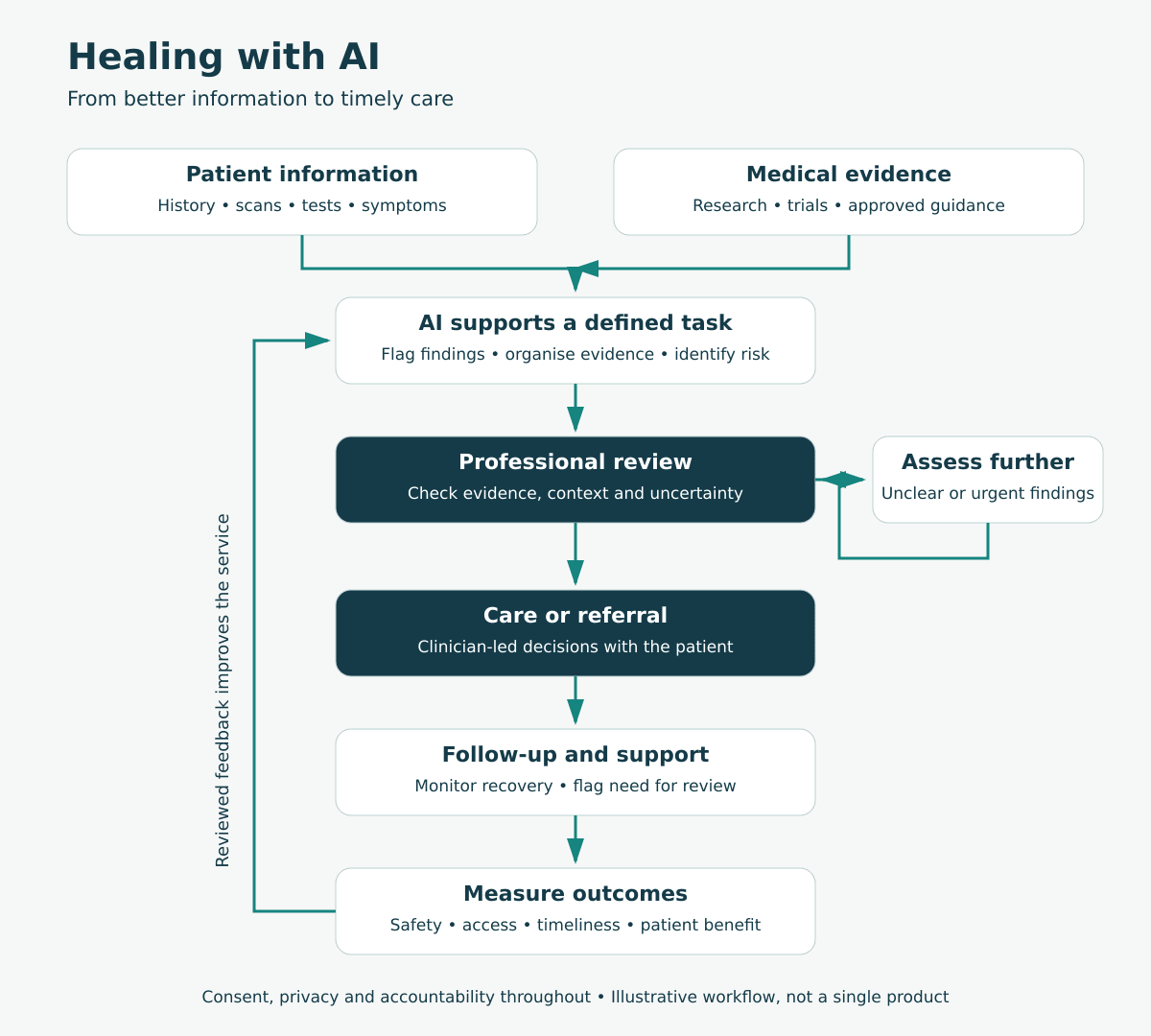
Where AI can help
Finding disease earlier. AI can assist trained professionals in reviewing X-rays, mammograms, retinal photographs and pathology images. It can highlight suspicious areas and help prioritise urgent cases. Screening flags a possible problem; further assessment establishes what it means.
Supporting clinical decisions. Systems designed and validated for a particular task can bring together test results, medical history and relevant research. They can help clinicians consider risks and investigate findings. A convincing answer from a general chatbot, however, is not equivalent to a validated medical tool.
Developing treatments. AI can help researchers explore biological targets, design candidate molecules and compare clinical trials. It can also organise the evidence needed to understand benefits, safety and gaps in knowledge. Laboratory work, human trials and regulatory assessment remain essential.
Supporting recovery and continuing care. AI can help organise follow-ups, identify patients who may need additional support and make approved care instructions easier to understand. Monitoring tools may flag changes for clinical review. Such support only becomes useful when someone can respond to the alert.
Giving healthcare workers more time. Drafting consultation notes, summarising records and helping with routine administration can reduce repetitive work. Clinicians must still check the record, but better information flow can leave more room for listening and explaining. WHO identifies clinical care, administration, education and research among the potential uses of generative AI in health.[1]
What advances have been reported?
More breast cancers detected, with fewer screen readings
The Swedish MASAI randomised trial provides an important example. In a published analysis involving nearly 106,000 women, AI-supported mammography detected 6.4 cancers per 1,000 women screened, compared with 5.0 using standard screening. That represents a 29% relative increase in detection. Radiologists’ screen-reading workload fell by approximately 44%, without a statistically significant increase in false-positive rates.[2]
These results concern a specific screening workflow in Sweden. They are encouraging evidence for AI working alongside radiologists, rather than a guarantee that every product or setting will achieve the same outcome.
Drug discovery moving into human trials
In 2025, Nature Medicine published a phase 2a trial of rentosertib, an AI-discovered and AI-designed drug candidate for idiopathic pulmonary fibrosis, a serious lung disease. The randomised, placebo-controlled study involved 71 patients over 12 weeks.[3]
The milestone is that an AI-enabled discovery programme reached controlled testing in patients. A small, early trial cannot establish long-term benefit or safety; larger studies are needed. AI may accelerate parts of discovery, while the medicine must still earn confidence through clinical evidence.
AI becoming part of screening programmes
WHO’s 2025 policy statement reported that six computer-aided detection products met its performance standards for tuberculosis screening in people aged 15 years and older.[4] This shows how specific AI tools can move from demonstrations towards evaluated public-health use. Screening must still connect people to confirmatory testing and appropriate care.
Indian innovation - from research evidence to frontline care
Pienomial: Connecting the knowledge behind better treatment
Pienomial deserves attention for a part of healthcare that patients rarely see, the work of turning scientific information into usable evidence.
Its Knolens platform is designed to organise information from research publications, clinical trials, regulatory documents and other sources into connected knowledge. According to Pienomial, its life-sciences applications support research, clinical development, medical affairs and regulatory work.
Pienomial illustrates how AI can support the research and decision processes that precede treatment. Its published product descriptions establish intended capabilities, rather than independent proof of improved patient outcomes.
Qure.ai: Supporting faster stroke care in Assam
At Baptist Christian Hospital in Tezpur, Assam, a study examined the introduction of Qure.ai’s qER software to assist interpretation of brain CT scans. The peer-reviewed study reported shorter time to treatment after implementation; Qure.ai summarised the reduction as 27%.[7]
This was a study at one hospital, rather than a randomised trial across many centres. Even so, it offers a practical example of AI supporting a care team where specialist access is limited. Faster information becomes valuable when it helps clinicians act sooner.
NIRAMAI: Making breast screening more accessible
NIRAMAI’s Thermalytix combines thermal imaging with AI to assess breast abnormalities. Its portable, radiation-free approach is designed for settings that include clinics and outreach programmes.
The relevance for India lies in bringing screening closer to women who may face travel, privacy or access barriers. An abnormal result still needs clinical evaluation. Thermal screening should not be presented as a universal replacement for established breast imaging or diagnosis.
Wadhwani AI: Helping patients stay connected to TB care
Wadhwani AI’s Prediction of Adverse TB Outcomes programme identifies patients who may be at higher risk of outcomes such as loss to follow-up or death during treatment. Working with India’s Central TB Division, it supports healthcare workers in directing additional follow-up towards higher-risk patients.
What India must get right
Health AI needs testing in the populations and settings where it will be used. Performance can vary with equipment, patient characteristics and the quality of available records. Local languages, connectivity, affordability and staff training influence whether a promising tool becomes useful in practice.
Privacy, informed consent and clear accountability are equally important. WHO warns that generative systems can produce inaccurate or biased information and encourage over-reliance on automated answers.[1] Hospitals and developers should measure what changes for patients: delays, missed diagnoses, treatment continuity, costs and outcomes.
India’s opportunity is to connect its AI capability with the everyday realities of care. Healing with AI should mean that a patient is noticed earlier, a clinician has better evidence, and a health worker can reach someone who needs help. The technology succeeds when it strengthens the people and systems that deliver care.
