

August 2026
Visual Intelligence reshaping our lives.
By Kshitij Sharma, CEO Paralaxiom Technologies
The unique sensory world experienced by each living species and an individual around us is denoted by Umwelt, which was popularized by Ed Wong in his best selling book An Immense World: How Animal Senses Reveal the Hidden Realms Around Us. Umwelt is the concept that an entity's intelligence is fundamentally shaped by its sensory inputs. While a bat experiences the world through echolocation and a dog through scent, human tools, communication language, etc. are dominated by the visible spectrum.
If we have to share context of the world around us with a machine, the physical reality that we would share with them will need to be dominated with what we see and feel.
Vision as a concept of machine learning has very old applications. In 1989, Yann LeCun applied Convolutional Neural Networks (CNNs) with backpropagation at Bell Labs to read handwritten digits. While this was a shallow network by today's standards, it was the direct historical proof-of-concept that neural networks could handle character recognition. I attempted OCR of Hindi printed characters using a combination of feature engineering and 2-layer neural network in 1997. The deep learning breakthrough happened with AlexNet winning the ImageNet Large Scale Visual Recognition Challenge (ILSVRC) in 2012 and that led to foundational architectures being developed for object detection, image segmentation, etc. Cut to today, and we are accustomed to seeing AI demos where bounding boxes cleanly frame cars, pedestrians, machines on an assembly lines, or boxes on a conveyor belt.
This picture does tell a thousand words, however, detecting an object is merely the first mechanical data-extraction step. To understand true visual intelligence, a pipeline looks at multiple subsequent frames. A model like YOLO (You Only Look Once) is excellent at object detection, but it effectively gives information from a single frame. If it spots a vehicle in Frame 1 and again in Frame 2, it does not inherently know it is looking at the same physical object. The architects of a visual intelligence platform pass the metadata obtained for each frame through another contextual state machine.
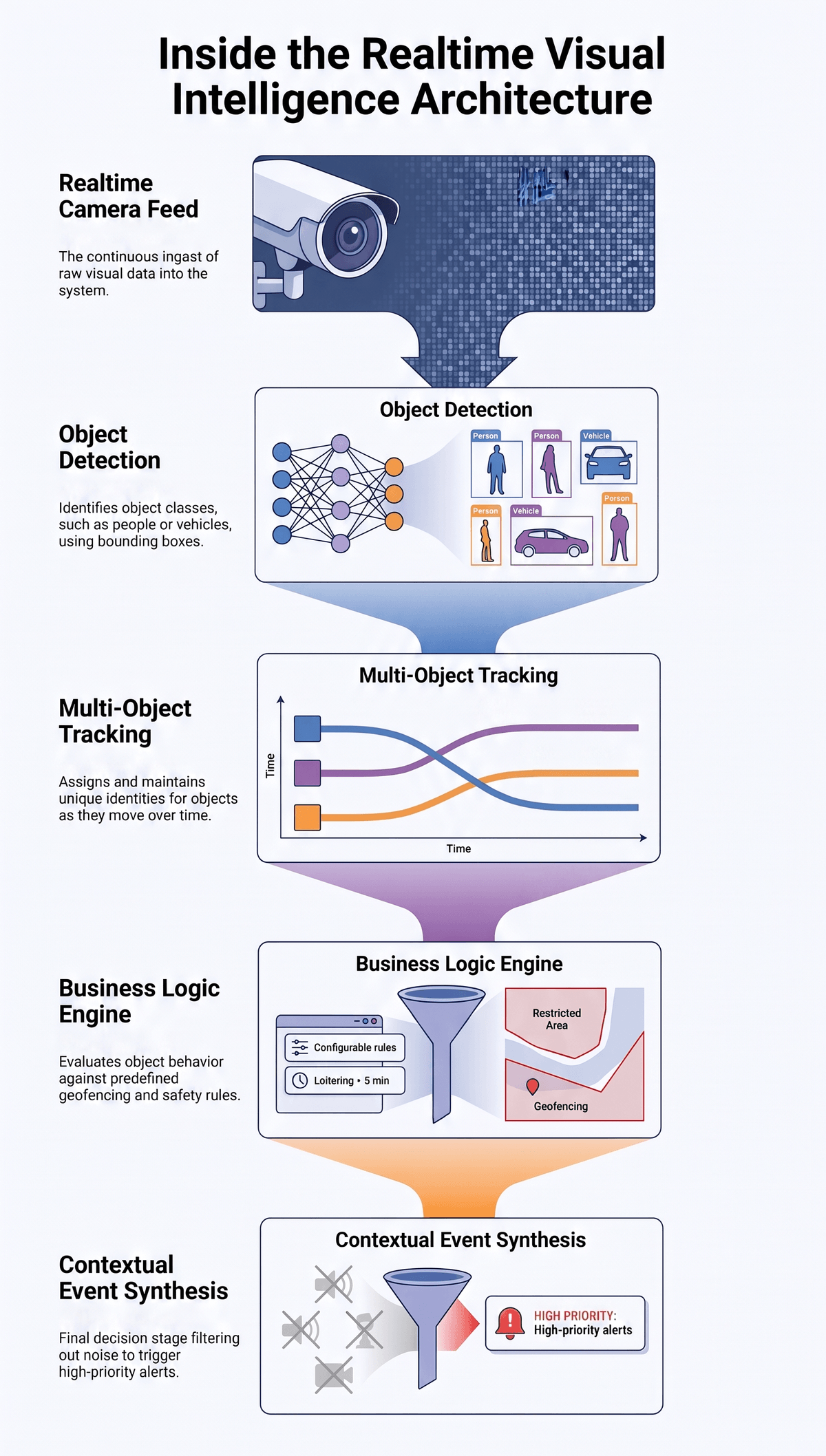
In simple words, if we look at just one frame on a camera, we cannot find out if there is an intruder. However, if we define the right geofencing rules, we can immediately decide if this there is a security guard patrolling or a person on the other side of the fence planning to jump inside.
The Three Pillars of Visual Intelligence
The following three pillars are important for intelligence derived from vision applications
I. Temporal AI and Action Recognition
Bounding boxes reveal where an item is. True intelligence requires understanding what that asset is doing. By tracing human skeletal keypoints and parsing movement changes over time, systems can differentiate complex, abstract human actions. This allows an AI pipeline to distinguish between a warehouse technician safely bending over versus falling down as an accident.
II. Vision-Language Models (VLMs)
The intent of the architects is not to create a complex system, but deep learning inherently is complex. Visual intelligence tools exist to handle that complexity ensuring the technology remains powerful for engineers while becoming effortless for the people using it every day.
Traditional computer vision models are trained on strict, rigid datasets to recognise specific objects. Modern visual intelligence integrates Vision-Language Models to the object recognition pipelines and hence leads the way to reasoning. Instead of forcing the users to go through training and remember complex configuration workflows, a natural language interface allows users to query the system conversationally. This makes the insights immediately accessible, and this process lowers the barrier to entry for users to interact with the system.
III. Applications
Visual Intelligence pillars allow users to interact with the system in plain language without going into complex workflows. Modern visual intelligence integrates Vision-Language Models to let operators interact in their local language allowing security guards or floor workers to simply speak to the system in their native language instead of navigating a complex software interface.
1. Safety – With applications across industry, public vigilance and national security
Instead of hardcoding a rule to look for a "person" crossing a line, users can prompt the system using natural language: "Alert me if anyone looks like they are trying to climb over the secure perimeter fence," or "Flag any worker who is not wearing hard hats and jackets near the heavy machinery." This will then lead the machine to look for person objects and heavy machinery and then apply the rules that if a person is alone, then it is safe, but if heavy machinery is around, then the detection of hard hat and jacket is a must.
In another example, a safety officer on the shop floor prompt the system to "detect whether a forklift is present on a factory floor, monitor it and nearby pedestrian traffic and to actively shut down the machine if an employee steps into a zone too close to the moving forklift." Visual intelligence entails giving such a prompt to the system.
Similarly Vision intelligence can support law enforcement agencies and armed forces in monitoring public places, sensitive areas, borders and any untoward activities.
2. Retail
For a retail setup such a system would counts the total number of shoppers walking through the front entrance doors. It can then detect precise customer engagement at specific locations thereby giving an accurate heatmap of the system, through intuitive dashboards and natural language interfaces.
Using CCTV cameras, we have deployed stock taking applications for industrial warehouses. We track stock usage over time by comparing baseline shelf imagery against current states and we then flag out-of-stock goods automatically without manual aisle audits.
3. Smart Traffic Intersections (Flow Optimization)
The old wasy is to use loop detectors embedded in the asphalt on roads or basic motion triggers using sensors inside factories and highways to count how many vehicles pass a line or trigger a red light.
With Visual Intelligence, the system can detect and classify road users (separating commercial trucks, bikes, and pedestrians), estimate queue lengths dynamically and adjust signal timing based on real-time density rather than fixed timers.
4. Healthcare
Healthcare industry is seeing large scale opportunity and applications for vision intelligence, ranging from training of medical staff, reading and analysing radiology images, surgical assistance, patient monitoring, as also above applications of managing safety and footfalls across healthcare centres and hospitals.
5. Mobility and Transportation
Perhaps, the most awaited application (having reached a certain degree of success) is leveraging vision intelligence for autonomous vehicles and autonomous transportation. This is a complex area posing multiple challenges in object identification during trying circumstances, and real time decision making. A lot of advancements have been made, with many more to follow.
Conclusion: The Era of Seeing Systems
Visual intelligence bridges the gap between raw data calculation and deep situational awareness. Cameras are no longer passive recording devices meant for forensic post-incident reviews. By pairing robust spatial metadata manipulation with natural language reasoning, action tracking, and edge computing, visual intelligence allows the software to develop human-like sight and changing the way machines navigate and interact with our physical world.
